





If you’re parenting a school-age child right now, you’ve probably felt this tension:
You want your child to be able to reach you.
You want them to have independence.
But you don’t want to hand them a phone before they’re truly ready.
Phones are showing up younger and younger. What used to feel like a middle school decision is now creeping into elementary school, often driven by logistics and safety rather than readiness.
We found ourselves stuck between two uncomfortable choices:
- Give our child a phone earlier than we felt good about
- Or limit their ability to reach us when they actually needed to
Neither option felt right.
Why Phones (Even Dumb Phones) Aren’t the Simple Fix They’re Marketed to Be
Many families try to solve this by choosing a “dumb phone” or heavily restricted phone. On paper, it sounds like a reasonable middle ground.
In real life, it’s rarely that simple.
According to Common Sense Media, more than half of parents say managing their child’s device settings is harder than they expected – even with parental controls in place.
Phones, regardless of how limited they’re marketed to be, tend to come with:
- Being easily lost, forgotten, or left behind
- Messaging that becomes socially complicated very quickly
- Settings that can be changed or influenced by peers
- Group texts and social pressure, even without apps
- Reliance on Wi-Fi (most often when using an old phone as a dumb phone) which creates communication gaps
Research from the Pew Research Center also shows nearly 60% of parents worry their child’s phone use interferes with attention, behavior, or sleep AND 54% of teens say themselves that they spend too much time on their phones – even with restrictions in place.
We realized our concern wasn’t just what our child could access. It was the constant management and unintended social consequences that came with phones.
Why We Believe in Waiting on Smartphones
Because of those statistics (and a million other reasons), I’m a strong believer in delaying smartphones as long as possible.
Movements like Wait Until 8th exist for a reason: kids benefit from more time before stepping into full phone culture. More focus. More sleep. More real-life connection.
But believing in waiting doesn’t erase the need for communication.
Kids are at friends’ houses. At practices. At games. At school events. Hanging at neighbors. They need a way to reach us – and we need a way to reach them – without handing over a device that opens doors we’re not ready to open.
Our Life-Changing Middle Ground: An Apple Watch Instead of a Phone
We chose an Apple Watch set up with its own phone number (and therefore GPS), and it completely changed how we handle communication.
It allowed us to stick to our values around waiting on phones without sacrificing safety or independence.
On Them, Simple, and Hard to Mismanage
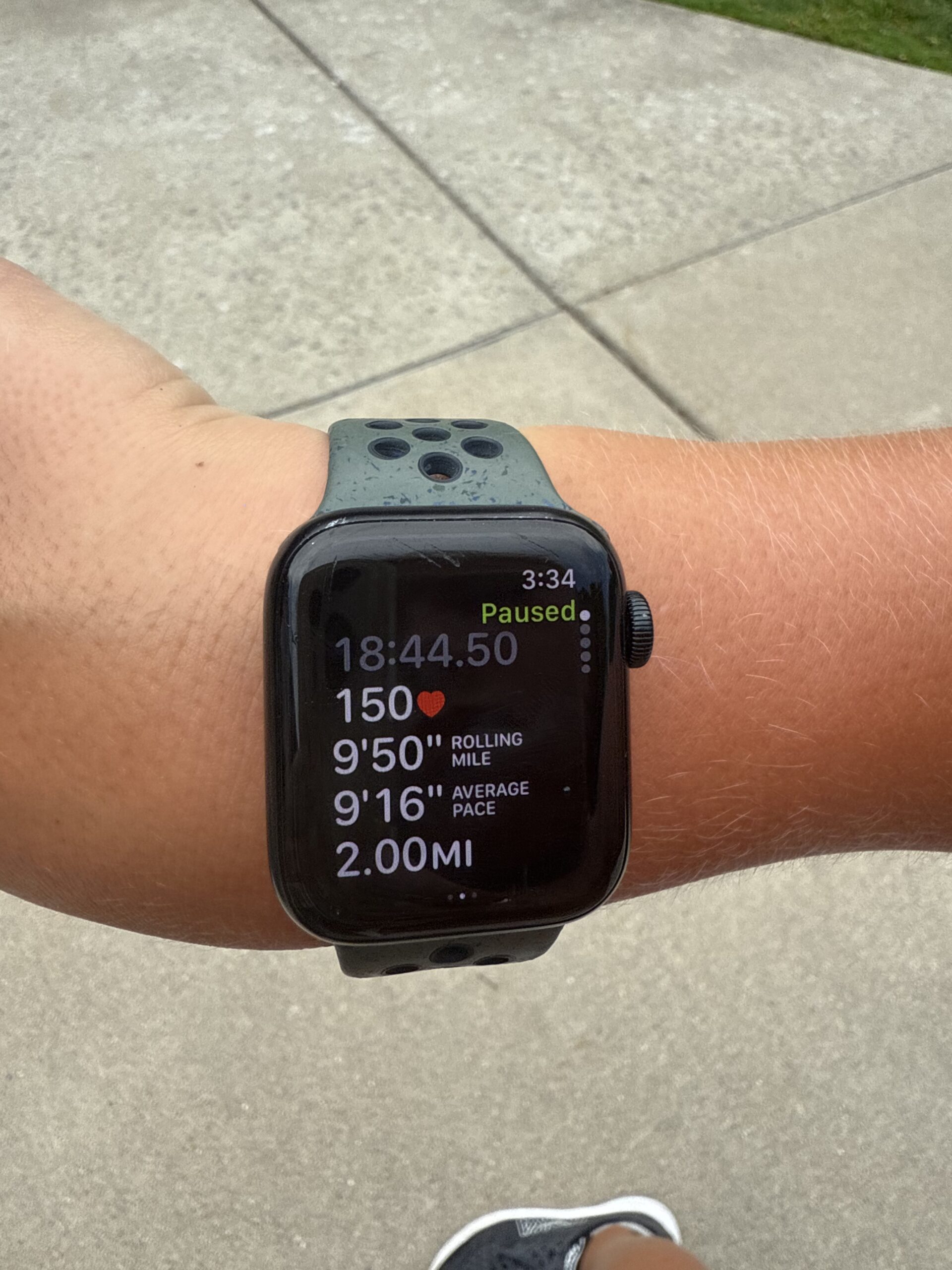
When needed (emphasis on when needed… not always) the watch is right on their wrist. There’s no phone to lose in a backpack or pocket, forget at practice, leave on a bus, or hand to another kid. It’s just there when they need it and left home on the counter or in a parent’s bag when they don’t.
It also does not rely on Wi-Fi. Because it has its own cellular plan (and phone #), our child doesn’t need to ask for a password or depend on an internet connection to reach us.
And just as important: other kids can’t control it and unlike a landline (which i also LOVE btw) it can travel with them.
Phones are easily influenced by peers – group texts, app suggestions, settings changes, social expectations even with the best of screen time controls or parental monitoring apps. With the watch, everything stays parent-controlled via the parents phone that it is linked too. Contacts must be approved. Features are limited / set by parents passcode / etc. There’s no swapping phones or social comparison.
It Blends In – No Peer Pressure, No Awkwardness
The watch looks like a sporty accessory, not a phone. It often goes unnoticed by peers and even other parents.
Because it blends in, it removes:
- Peer pressure
- Social signaling
- Feeling early or behind
It quietly does its job without becoming a status symbol.
Optional School Mode Makes Boundaries Automatic
During parent determined “school hours”:
- The watch is locked
- No messages
- No notifications
- No distractions
When school ends, communication turns back on automatically. Teachers don’t have to manage devices, kids stay focused, and parents don’t have to worry about enforcement. And BONUS, school mode does allow for emergency calls so I don’t feel like I’m hanging them out to dry should they need to reach us ASAP.
Communication Without Social Overload
Every number that can call or text the watch must be approved by us.
- No random contacts
- No group texts with unapproved “friends”
- No unknown numbers
- No notifications / Need for peer approval with Likes, Loves, + Comments.
Our child can reach us (or whomever we determine OK) at anytime – but only within guardrails we control.
Safety Without Awkwardness
Kids don’t always want to ask another adult / peer for help. They don’t want to feel embarrassed or draw attention to themselves.
With the watch:
- Our child can quietly call/text us anytime
- No asking a friend’s parent to borrow a phone or asking a friend to borrow a device
- No waiting
- No discomfort
We’ve even had a child staying at our house who felt sick in the middle of the night and used their watch to call their mom – who then called me for a plan. For this child + family it made the situation calm, discreet, and reassuring for everyone. (Made me feel terrible that they were secretly barfing in the bathroom but nice to know we all had those options for lines of communication).
Ideal for Sports Families, Busy Schedules, and those of us trying to parent like the 90s but know its not.
- We can track location
- Kids can call if plans change
- Let them have freedom at sports complexes, fields, hotels, etc. without worry or hesitation
- Pickups/Dropoffs are easier
- Let them “roam” the neighborhood without calling 15 houses to track them down
It gives kids independence without disconnecting parents….
| Feature | Smartphone | Dumb Phone | Apple Watch |
|---|---|---|---|
| Can call parents anytime | Yes | Yes | Yes |
| Has its own phone number | Yes | Yes | Yes |
| Requires Wi-Fi to function fully | Sometimes | Sometimes | No (w/ Cell Plan) |
| Easy to lose or forget | Yes | Yes | Sometimes |
| Parent-approved contacts only | Limited | Sometimes | Yes |
| Group texts | Yes | Sometimes | Sometimes |
| Social media access | Yes | No | No |
| Internet browsing | Yes | Limited | No |
| School Mode | Limited | Limited | Yes |
| GPS tracking | Sometimes | Sometimes | Yes |
| Photo sending | Yes | Sometimes | No |
| Peer pressure factor | High | Moderate | Low |
Why This Worked for Our Family
We’re standing firm on the commitment to wait – and we made it workable for our needs.
- Support delaying a phone / social media / solo internet access
- Meet real-world safety needs
- Avoid early phone culture
- Reduce pressure, distraction, and overexposure
Our child feels trusted. We feel connected. And we gained more time before introducing a phone.
If you’re trying to balance strong values with real-life logistics, this may be the middle ground you’ve been looking for.